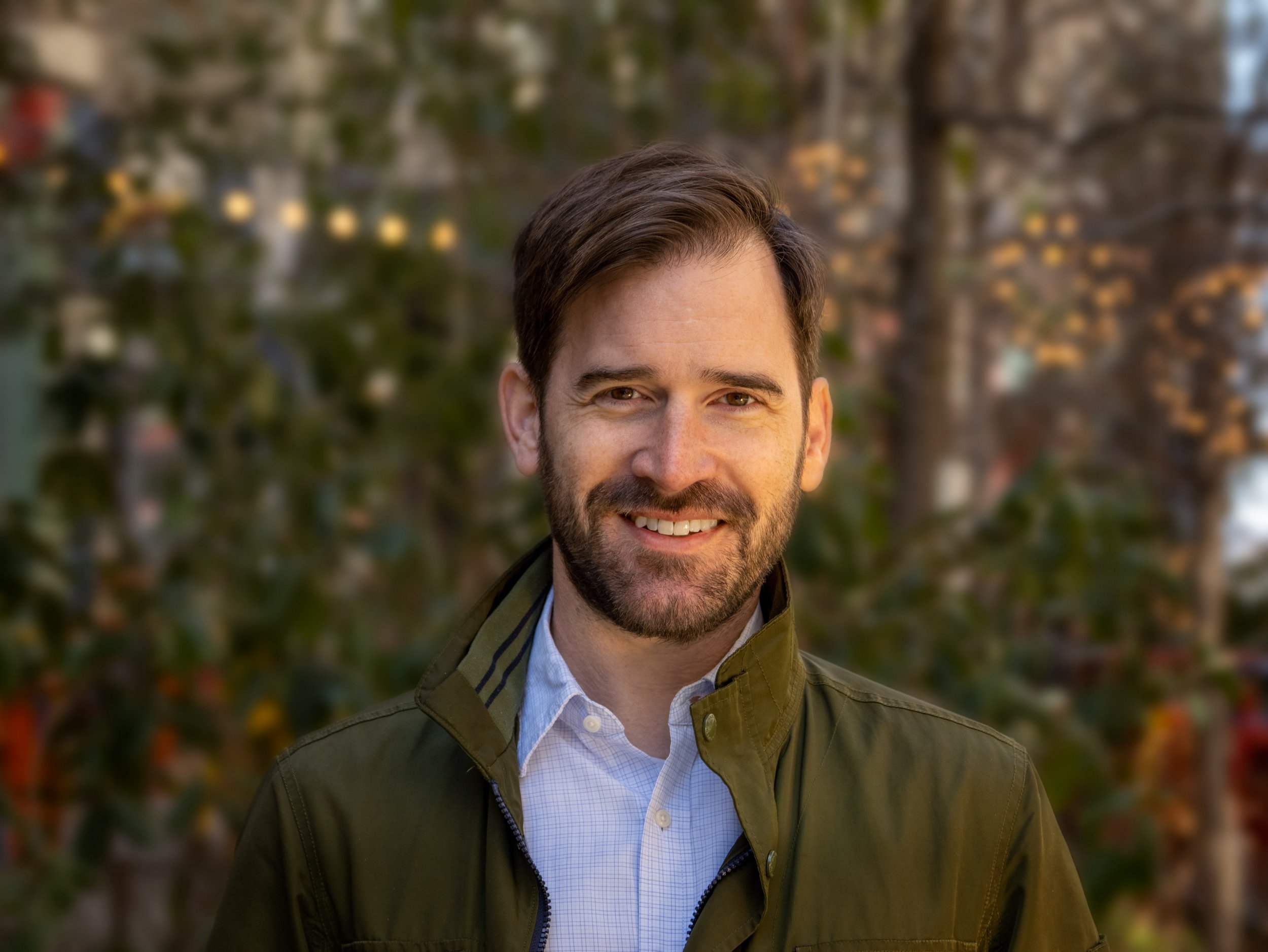
My brother and me at SXSW

Posted on March 18th, 2008 by dan.
Categories: connections, press, performing, music, live visuals, history.


Dan and Pete labels, originally uploaded by ekornblut.

Last week Emily and I went to Austin for SXSW. I did visuals for a laptop battle (much fun), saw the premiere of Blip Festival: Reformat the Planet, a documentary I’m in about the chipmusic scene, answered some audience questions afterwards with the filmmakers, and had many delicious breakfast tacos. Pete tagged me as an uber-micro-neo-kraut with stickers from the Last.fm/moo.com/Etsy/Timbuktu party. Emily thinks it ought to be my new visualist handle. Here’s the trailer for the documentary.


BLIP FESTIVAL: REFORMAT THE PLANET trailer from 2 Player Productions on Vimeo.

0 comments.

work-in-progress documentary on Bill Etra

Posted on February 21st, 2008 by dan.
Categories: visualists, videoartists, artist, hackers, friends, history.

Benton-C Bainbridge has been shooting interviews with Bill Etra for years and, for the past year and a half, has been assembling a documentary about his life and work. The “sampler cut” below highlights some of the more recent interview footage interspersed with some of Bill’s work over the years. If you don’t know of Bill, he is a pioneer in video engineering, design and performance, and one of the handful of people who can rightly be said to have been the first to do live visuals. This Wired article from 2000 gives a pretty good background.

0 comments.

No Water

Posted on August 10th, 2006 by dan.
Categories: politics, nyc, war, america, history.

“Terrorists can be defeated simply by not becoming terrorized — that is, anything that enhances fear effectively gives in to them.”*

This moment in history will be remembered as a high-water mark of fear and hysteria, a time when small groups of men successfully bred fear around the world, a fear which politicians encouraged and manipulated to secure their control over government. Today I called my Congressman and Senators’ offices to ask them to speak out against this “no liquids” policy on airplanes and the manipulation of this foiled act of terrorism by the party in power to make people more fearful, and thus, more easy to control. The response by our government to acts of terrorism is turning our country into a fearful, reactionary monster. I hope you’ll call or write your representatives, too.

http://house.gov
http://senate.gov

* From “A False Sense of Insecurity?” (alternate link), an essay by John Mueller from the Cato Institute’s Regulation magazine.

0 comments.

icons

Posted on March 24th, 2006 by dan.
Categories: war, nyc, america, art, history, philosophy.

We knew (I knew!) we had never been modern, but now we are even less so: fragile, frail, threatened; that is, back to normal, back to the anxious and careful stage in which the “others” used to live before being “liberated” from their “absurd beliefs” by our courageous and ambitious modernization. Suddenly, we seem to cling with a new intensity to our idols, to our fetishes, to our “factishes,” to the extraordinarily fragile ways in which our hand can produce objects over which we have no command. We look at our institutions, our public spheres, our scientific objectivity, even our religious ways, everything we loved to hate before, with a somewhat renewed sympathy. Less cynicism, suddenly, less irony. A worshipping of images, a craving for carefully crafted mediators, what the Byzantine called “economy,” what used to simply be called civilization.

||

from ICONOCLASH (html + pdf)

0 comments.

the age of the world picture

Posted on March 10th, 2006 by dan.
Categories: maps, Grad school, history, philosophy.

Heidegger has blown my mind. You see, the big question that has always most fascinated me is how do/did people — especially those who lived hundreds or thousands of years ago — see the world? What is/was their worldview? The nugget of Heidegger’s argument in this essay is that before the modern era, there was no awareness that there was a worldview or that there could be multiple worldviews. This is particularly relevant when many violent people want to roll the world back to medieval times.

I need to pull a better quote than the below.

The gigantic is rather that through which the quantitative becomes a special quality and thus a remarkable kind of greatness. Each historical age is not only great in a distinctive way in contrast to others; it also has, in each instance, its own concept of greatness. But as soon as the gigantic in planning and calculating and adjusting and making secure shifts over out of the quantitative and becomes a special quality, then what is gigantic, and what can seemingly always be calculated completely, becomes, precisely through this, incalculable. This becoming incalculable remains the invisible shadow that is cast around all things everywhere when man has been transformed into subiectum and the world into picture.

By means of this shadow the modern world extends itself out into a space withdrawn from representation and so lends to the incalculable the determinateness peculiar to it, as well as a historical uniqueness. This shadow, however, points to something else, which is denied to us of today to know. But man will never be able to experience and ponder this that is denied so long as he dawdles about in the mere negating of the age. The flight into tradition, out of a combination of humility and presumption, can bring about nothing in itself other than self-deception and blindness in relation to the historical moment. [emphasis mine]

Man will know, i.e., carefully safeguard into its truth, that which is incalculable, only in creative questioning and shaping out of the power of genuine reflection. Reflection transports the man of the future into that “between” in which he belongs to Being and yet remains a stranger amid that which is. Holderlin knew of this. His poem, which bears the superscription “To the Germans,” closes:

How narrowly bounded is our lifetime,
We see and count the number of our years.
But have the years of nations
Been seen by mortal eye?

If your soul throbs in longing
Over its own time, mourning, then
You linger on the cold shore
Among your own and never know them. *

From a reading for my history of media class. There were several more striking sections — and I’m sorry if this fragment is incomprehensible for most of you — but it’s time for bed.

* Martin Heidegger, “The Age of the World Picture” (from The Question Concerning Technology and Other Essays [New York: Harper & Row, 1977], rpt. in Timothy Druckery, ed., Electronic Culture: Technology and Visual Representation [New York: Aperture, 1996])

0 comments.

Baudrillard

Posted on November 10th, 2005 by dan.
Categories: history.

20051110 - history

Baudrillard discussion.

  • read raymmond William’s “Television”
  • send link to Ballard’s review of cinema book
  • get that book back from Dad

These would be the successive phases of the image: 1) It is the reflection of a basic reality. [sacrament] 2) It makes and perverts a basic reality. [malifice] 3) It masks the absence of a basic reality. [sorcery] 4) It bears no relation to any reality whatever: it is its own pure simulacrum. [simulation]

But what could art possibly mean in a world that has already become hyperrealist, cool, transparent and marketable?

  • ____ needs a hearing aid that is activated when anyone speaks, and whispers in their ear “but that’s just one person’s opinion and they could be wrong”. in this way, relativist contextualism might be continually propitiated.

  • historical visigoth, modern goth - dominic: ‘that’s your paper’

  • baudrillard’s post-human is nostalgic

  • read about Bataille’s ‘accursed share’

  • dominic: ‘my brain is full of cartoons and i’m neither miserable nor happy’

HOMEWORK: - Kittler’s introduction and some of the rest. Bukatman.

0 comments.

relations

Posted on October 29th, 2005 by dan.
Categories: history.

We had a really good, spirited discussion today about science.

CULTURE SHOCK. - think about my own experiences of culture shock - new, constant state of culture shock

  • massive shift in wealth upwards in past 20 years

    • benefits status quo
  • Luciana suggests “Representing and Intervening”

  • other term paper topic: changes in comedy and humor in media

  • read Edgar Allen Poe’s “Descent into the Maelstrom”

  • ?connection between pop music and fascism in Germany in the 30s?

  • roots of vagueness

  • remind Carl about “no, dude, the medium IS the message”

  • send carl link to my perfection essay

0 comments.

history

Posted on October 20th, 2005 by dan.
Categories: history.

20051020 - history

  • many different economies, not just capital. symbolic; gift;

  • where the hell did ‘russian roulette’ come from?

  • chompksy site bittorrent of ‘century of the self’

  • anthropology, psychology, sociology, marketing, branding, adveritsing (’dream worlds of consumption’) — weren’t they all born at roughly the same time? and they have struggled to move closer and get away from each other (depending) like the snakes on the pole

  • ‘a sucker’s born every minute’ - cross-reference gullibility studies to birthrates :)

  • origin of dollar sign: apothecary, caduceus,

  • neo-pre-post-ironists

new history prof: deborah levitt

new phil prof: michael t. zimmer

0 comments.